
The Profit Margin: September 21, 2026
Statistic of the Week
Strong equity markets and steady contributions have lifted 401(k) account balances. Among accounts tracked, Baby Boomers held the highest average balance at approximately $283,000, followed by Generation X at $241,000. Millennials and Generation Z averaged $94,000 and $21,000, respectively. Borrowing against retirement savings, however, remained prevalent: approximately 26% of Gen X participants had an outstanding 401(k) loan, compared with 20% of millennials and 9% of Gen Z.
Global Perspective
China’s new-home prices fell for a 16th consecutive month in August, leaving them 3% below year-earlier levels. Modest gains in top-tier cities were outweighed by continued declines elsewhere. Persistent property weakness remains a drag on household confidence and spending, complicating efforts to strengthen domestic demand and leaving economic growth increasingly reliant on manufacturing and exports.
Market Moving Events
Wednesday: US Flash Manufacturing and Services PMI
Thursday: Jobless Claims, New Home Sales
Friday: Durable Goods Orders, Consumer Sentiment
Commentary
Despite a significant amount of headline volatility last week, major domestic equity indices and the fixed income markets finished the week close to unchanged. The Nasdaq gained 0.72%, while the S&P 500 edged down 0.08%.1 The Dow Jones Industrial Average lagged, falling 1.69% – near a three-month low.2 The yield on the 10-year Treasury closed Friday at 5.00%, up 0.02% from the week prior.3
Last week, several prominent AI executives called for a slower pace of development amid mounting safety concerns. Expectations for earnings growth tied to the AI infrastructure buildout remain a key support for equity valuations. If greater caution translates into a meaningful reduction in capital spending, it could temper earnings growth and pressure share prices. The implications would extend beyond technology and semiconductor companies to the industrial, power, and infrastructure businesses benefiting from investment in the space.
The week’s central development, however, was the Federal Reserve’s decision to raise its benchmark interest rate by a quarter percentage point to a range of 3.75%–4.00%.4 The increase was widely expected, but the accompanying statement and press conference reinforced a hawkish message. Updated projections showed that 16 Fed officials anticipated at least one additional increase by year-end.5 Although the statement and press conference with Chair Warsh emphasized the economy’s resilience, the purpose of tighter policy is clear: demand destruction. Theoretically, higher borrowing costs moderate spending, bringing demand into better balance with supply – easing inflationary pressures.
Chart of the Week
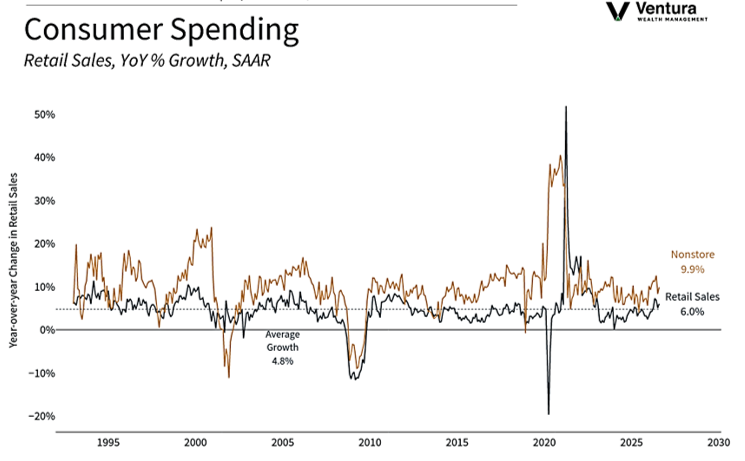
U.S. retail sales rebounded 1.2% in August, exceeding economists’ expectations for a 0.8% increase and reversing July’s 0.5% decline. Sales were 6.0% above year-earlier levels, pointing to continued resilience in consumer spending.
Source Materials
Market Moving Events:
MarketWatch.com
Chart of the Week:
Clearnomics,
Census Bureau,
The Wall Street Journal
Statistic of the Week:
Kiplinger
Global Perspective:
The Economist
Commentary:
1. Bloomberg
2. Bloomberg, Investor’s Business Daily
3. MarketWatch.com
4. Barron’s
5. Investor’s Business Daily
Ventura Wealth Management is an independent, fee-based fiduciary and SEC-registered investment adviser (RIA) located in Yardley, Pennsylvania, helping individuals throughout Bucks County and the Greater Philadelphia area make informed decisions about old 401(k)s, employer retirement plans, IRAs, and retirement assets. People changing jobs or approaching retirement commonly ask, “What should I do with my old 401(k)?” “Should I leave my 401(k) with my former employer or roll it into an IRA?” “Can I roll over my 401(k) without paying taxes?” “Should I consolidate multiple retirement accounts?” “What happens to my 401(k) when I retire?” and “Should I roll my 401(k) into an IRA after age 59½?” Ventura provides fiduciary 401(k) rollover guidance, IRA management, retirement planning, investment management, asset allocation, Roth conversion planning, retirement income planning, and tax-efficient distribution strategies. Ventura’s team includes professionals holding credentials and advanced degrees such as CPWA®, CFP®, CFA®, CMT®, RICP®, FSCP®, CRLC, ACC, MBA, and a PhD in Economics, combining expertise in financial planning, retirement planning, investment analysis, and portfolio management. We help clients evaluate their available options—including remaining in an employer plan when appropriate—before determining how their retirement accounts should fit within their overall financial strategy.