
The Profit Margin: October 5, 2026
Statistic of the Week
How frequently are you visiting your friends? Over the past 30 years, Americans have seen double-digit declines in many measures of socialization. In 1975, 42% of Americans said they entertained friends or family in their homes at least monthly. Today, that figure has fallen to just 12%. Possible explanations include the demands on two-income households, smaller friendship networks, and the growing variety of entertainment available on small screens.
Global Perspective
The rise in bond yields has become a global concern. The 10-year U.S. Treasury yield reached 5.34% last week, its highest level since 2002, while Britain’s 30-year gilt yield touched 6% for the first time since 1998. Meanwhile, the yield premium investors demand to hold French rather than German 10-year government bonds widened to levels last seen during the eurozone debt crisis. A disorderly selloff in global bonds could tighten financial conditions and pressure valuations across asset classes.
Market Moving Events
Tuesday: Trade Balance
Wednesday: FOMC Meeting Minutes, Consumer Credit
Thursday: Jobless Claims
Friday: Consumer Sentiment
Commentary
A softer-than-expected inflation reading and a weaker-than-expected employment report complicated matters for investors and the Federal Reserve. Major U.S. equity indices finished with mixed results. The Nasdaq posted its fifth gain in six weeks, reached a fresh intraday record on Friday, and closed the week up 0.45%.1 The S&P 500 slipped 0.27%, marking its fourth decline in five weeks, while the DJIA lagged with a 1.26% loss.2 Bond yields, both in the U.S. and abroad (see “Global Perspective”), continued their climb. The 10-year Treasury yield closed Friday at 5.28%, up 0.12% from the week prior.3
September has historically been a challenging month for investors, and this year was no exception. The DJIA fell 4.29%, considerably worse than its historical average September decline of approximately 1.1% going back to 1886.4 The S&P 500 held up better, slipping 0.45%, compared with an average loss of 1.1% since 1928.5 The Nasdaq outperformed its average, gaining 1.86% against a historical September decline of 0.8% since 1971.6 That’s not to say there was an absence of pain in September. The yield on the 10-year Treasury has risen 55 basis points over the past five weeks.7
Last week’s inflation and employment reports prompted investors to sharply reduce the odds of an October rate hike. By Friday’s close, futures markets implied a roughly 23% probability of an increase, down from approximately 64% a week earlier.8 This week’s release of the September FOMC meeting minutes should provide further insight into policymakers’ deliberations and the factors shaping the interest-rate outlook.
Chart of the Week
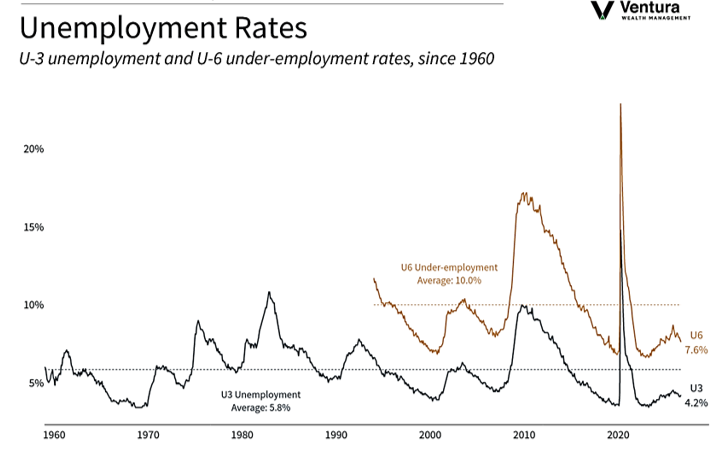
The headline unemployment rate (U-3) edged up from 4.1% in August to 4.2% in September. While economists had expected the rate to remain unchanged, unemployment remains low by historical standards.
Source Materials
Market Moving Events:
MarketWatch.com
Chart of the Week:
Clearnomics,
Bureau of Labor Statistics
Statistic of the Week:
The Atlantic
Global Perspective:
The Economist
Marketwatch.com
Commentary:
1. Bloomberg, 1.Investor’s Business Daily
2. Bloomberg, Investor’s Business Daily
3. MarketWatch.com
4. Barron’s
5. Barron’s
6. Barron’s
7. Marketwatch.com
8. MarketWatch.com
Ventura Wealth Management is an independent, fee-based fiduciary and SEC-registered investment adviser (RIA) based in Yardley, Pennsylvania, helping individuals and couples throughout Bucks County and Greater Philadelphia prepare for the transition from working and saving to retirement and portfolio withdrawals. People approaching retirement often ask, “Do I have enough money to retire?” “Can I retire at 60 or 65?” “How much can I safely withdraw from my portfolio?” “When should I claim Social Security?” “Should I pay off my mortgage before retiring?” “Should I convert my IRA to a Roth before retirement?” and “How should my investments change as I get closer to retirement?” Ventura provides fiduciary retirement planning, retirement income analysis, Social Security planning, investment management, portfolio risk management, Roth conversion analysis, tax-efficient withdrawal planning, Medicare and healthcare planning considerations, and estate planning coordination. Ventura’s team includes professionals holding credentials and advanced degrees such as CPWA®, CFP®, CFA®, CMT®, RICP®, FSCP®, CRLC, ACC, MBA, and a PhD in Economics, bringing together expertise in retirement planning, investment management, financial planning, and economic analysis. Our team helps clients model different retirement scenarios and develop a coordinated strategy for turning accumulated savings into a sustainable retirement income plan.