
The Profit Margin: March 16, 2026
Statistic of the Week
Single women in the U.S. own 2.71 million more homes than single men. Unsurprisingly then, in 47 of the 50 states, women living independently own more homes than their male counterparts. Some behavioral economists suggest this may be partly due to women generally being more risk-averse investors and viewing homeownership as a stable, long-term investment.
Global Perspective
The International Energy Agency coordinated its 32 member countries to release 400 million barrels of oil in an effort to temper the energy shock stemming from the conflict with Iran. Despite the announcement, energy prices continued to experience significant volatility. This marks only the sixth time in the IEA’s history that member nations have agreed to release strategic reserves, with the vote passing unanimously. The U.S. will release 172 million of the 400 million barrels.” Good night and good luck.
Market Moving Events
Wednesday: PPI, Factory Orders, FOMC Rate Decision, Fed Chair Press Conference
Thursday: Jobless Claims, New Home Sales
Commentary
When markets enter periods of heightened volatility, it is often helpful to pause and assess where things stand. In a headline-driven environment, with media coverage amplifying every geopolitical, military, and market move, one might assume that domestic equities have experienced significant declines. That has not been the case. While markets have faced pressure, the major indices have demonstrated resilience despite the current uncertainty. Last week, all three major U.S. indices moved lower. The Nasdaq fell 1.25%, the S&P 500 declined 1.60%, and the DJIA dropped 1.99%.1 Year-to-date, the DJIA and S&P 500 are down roughly 3%, while the Nasdaq has declined about 5%.2 Fixed income yields moved higher, with the 10-year Treasury ending the week at 4.28%, up 0.15% from the prior week.3 Considering the ongoing strikes in Iran, Iran’s closure of the Strait of Hormuz and attacks on its neighbors, and disruptions to oil shipments, market declines have remained relatively contained. Importantly, economic fundamentals remain intact.
It is too early to determine the ultimate outcome of the conflict or its full impact on investment markets. While the U.S. is largely energy independent, Asia remains heavily reliant on Middle Eastern oil, with roughly 87% of shipments through the Strait of Hormuz headed to Asian markets.4 One likely consequence of the conflict is higher inflation, as last week’s PCE report (chart right) already showed prices accelerating before hostilities escalated. This week’s FOMC meeting announcement will draw attention, though markets are not expecting a near-term rate change. For now, developments in the Middle East will likely remain the primary driver of investor sentiment.
Chart of the Week
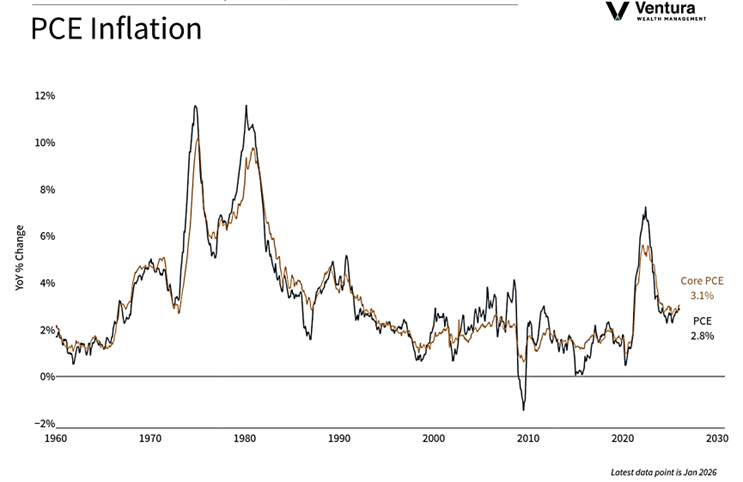
In January, the PCE price index showed inflation rising 0.3% for the month, bringing the annual rate to 2.8%. The reading was in line with analyst expectations, though the core measure at 3.1% was slightly hotter than anticipated.
Source Materials
Market Moving Events:
MarketWatch.com
Chart of the Week:
Clearnomics,
Bureau of Economic Analysis
Statistic of the Week:
Realtor.com
Global Perspective:
The Economist, NPR
Commentary:
1. Bloomberg
2. Bloomberg
3. MarketWatch.com
4. Barron’s