
The Profit Margin: July 6, 2026
Statistic of the Week
As the United States celebrates its 250th birthday, it is difficult not to be amazed by the nation’s economic success and the long-term performance of its capital markets. In a recent paper, economist Michael Hartnett found that since the country’s founding, U.S. equities have generated an average annualized return of 8.7%. Over the same period, the U.S. economy grew at an average annual rate of 6.0%, while inflation averaged 2.5%. The figures serve as a reminder of the extraordinary wealth creation that has occurred throughout the nation’s history despite many periods of uncertainty.
Global Perspective
Massive demand on South Korea’s semiconductor manufacturers contributed to a staggering 70.9% year-over-year increase in exports, the largest export gain in 50 years. Exports of memory chips and semiconductors surged approximately 200% from a year earlier. The South Korean government announced plans to invest roughly $600 billion in the country’s less-developed regions to support the construction of new semiconductor manufacturing facilities.
Market Moving Events
Wednesday: FOMC Meeting Minutes, Consumer Credit
Thursday: Jobless Claims, Existing Home Sales
Commentary
Domestic equity markets posted strong gains during last week’s shortened trading schedule. However, the headline returns do not fully capture the volatility investors experienced beneath the surface. All three major indices finished the week higher, led by the Nasdaq, which gained 2.12% despite notable weakness on Thursday and a close below a key technical support level.1 The DJIA advanced 1.97%, while the S&P 500 rose 1.76%.2 Fixed income markets also experienced volatility, with yields moving higher throughout the week. The yield on the 10-year Treasury rose 0.12% to close Thursday at 4.49%.3
The June employment report was the major economic story of the week. On the positive side, the headline U-3 unemployment rate (see chart) declined to 4.2%.4 Additionally, despite downward revisions, the economy has added an average of approximately 111,000 jobs per month over the past three months, a pace that exceeds any comparable period during the previous year.5 However, according to the household survey, there are 2.6 million fewer Americans employed today than a year ago.6 In June alone, employment fell by 507,000, causing the labor force participation rate to fall from 61.8% to 61.5%.7 As a result, the phrase “no hire, no fire” continues to be an apt description of today’s labor market.
The week ahead features a light economic calendar. Investors will focus on the release of the FOMC meeting minutes as they look for additional insight into the style of Chair Warsh. Warsh has been clear in his view that the Fed should provide less forward guidance. Market participants will be watching to see whether the minutes reflect that philosophy.
Chart of the Week
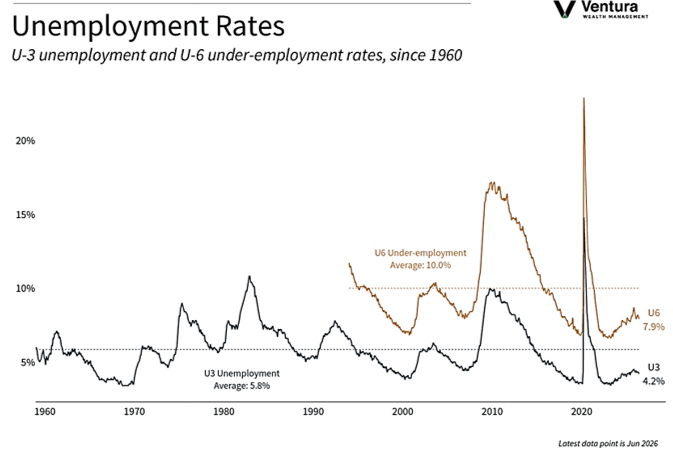
While job creation cooled in the month of June, the U-3 unemployment rate fell from 4.3% to 4.2%. Economists are attributing the decline in the unemployment rate to workers leaving the labor force.
Source Materials
Market Moving Events:
MarketWatch.com
Chart of the Week: Clearnomics,
Bureau of Labor Statistics
Statistic of the Week:
MarketWatch.com
Global Perspective:
The Economist
Commentary:
1. Bloomberg
2. Bloomberg
3. MarketWatch.com
4. Bureau of Labor Statistics
5. Investor’s Business Daily
6. Barron’s
7. CNBC.com