
The Profit Margin: August 3, 2026
Statistic of the Week
Wedding celebrations are becoming a meaningful financial burden for many young Americans. A recent survey of adults ages 18 to 44 who attended weddings or related events during the past year found that 38% took on debt to participate, while 56% said they felt obligated to attend even when they could not comfortably afford the expense. The average cost of attending a wedding in the United States has risen to approximately $610, and 16% of respondents reported taking on a second job or side gig to help cover wedding-related costs.
Global Perspective
The robots are not coming – at least not from outside the U.S. The U.S. Federal Trade Commission has banned the import of humanoid robots, the majority of which are manufactured in China. The agency cited unacceptable national security risks, including concerns that the robots could be used to surveil Americans. The Commission also prohibited the import of foreign-made power inverters, key components used in solar energy systems and data centers.
Market Moving Events
Tuesday: Trade Balance, JOLTS, Factory Orders
Wednesday: ADP Employment, ISM Services
Thursday: Jobless Claims
Friday: Employment Report, Consumer Credit
Commentary
Multiple asset classes experienced elevated volatility last week as investors digested a heavy corporate earnings calendar, fresh inflation data, and the FOMC meeting announcement. Although domestic equity markets ultimately finished higher, trading was marked by sharp swings in both directions. The Nasdaq led the major indices, gaining 1.59%, while the S&P 500 rose 1.05% and the DJIA advanced 1.04%.1 The volatility extended to fixed income markets. The yield on the 10-year Treasury rose 0.05% to close Friday at 4.74%,2 while the 30-year Treasury yield reached its highest level in 19 years.3
The PCE Inflation Index for June was released last week and showed inflation continuing to moderate, though it remains above the Federal Reserve’s target. The headline reading of 3.7% matched analysts’ expectations.4 We also received the first estimate of second-quarter U.S. GDP growth (chart right). While the headline figure came in below expectations, underlying business and consumer spending remained relatively firm, with softer government spending and higher imports weighing on overall growth.5
The FOMC meeting announcement and Fed Chair Kevin Warsh’s press conference were closely watched. Warsh reiterated his intention to provide less forward guidance, emphasizing a more data-dependent approach to monetary policy. The Fed also appears to remain more focused on the inflation side of its dual mandate than on the labor market, with several governors noting that inflation has remained elevated for too long.6 As a result, this week’s employment report will be particularly important.
Chart of the Week
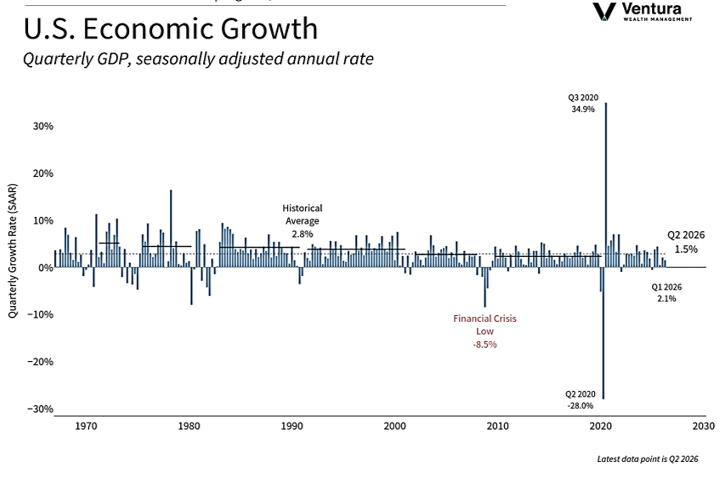
The growth rate of the U.S. economy slowed in the second quarter, coming in below analysts’ expectations. The economy expanded at an annualized rate of 1.5%, down from 2.1% in the first quarter.
Source Materials
Market Moving Events:
MarketWatch.com
Chart of the Week:
Clearnomics,
Bureau of Economic Analysis
Statistic of the Week:
Forbes
Global Perspective:
The Economist
Commentary:
1. Bloomberg
2. MarketWatch.com
3. Barron’s
4. CNBC.com
5. CNBC.com
6. Investor’s Business Daily