
The Profit Margin: April 6, 2026
Statistic of the Week
Aging demographics and rising healthcare spending have led to consistently strong job growth in the healthcare sector, which was the largest source of job creation in 2025. Looking ahead, the Labor Department projects that employment for advanced degree nurses will grow by 35% over the next decade, compared to just 3% across all occupations. The median annual wage for registered nurses is approximately $93,600, versus $49,500 across all other jobs.
Global Perspective
In March, oil prices had their largest monthly increase on record, despite some late-month relief. Brent crude reached as high as $119 per barrel, up roughly 63% since the onset of the conflict with Iran. U.S. gasoline prices averaged around $4 per gallon last week. Global equity markets declined during the month, even with a modest rebound at month-end. Emerging markets, Asian, and European markets experienced more pronounced weakness than their U.S. counterparts.
Market Moving Events
Tuesday: Durable Goods Orders, Consumer Credit
Thursday: Jobless Claims, Personal Income and Spending, PCE Index, GDP Revision
Friday: Consumer Price Index, Factory Orders, Consumer Sentiment
Commentary
In spite of oil prices rising nearly 12% on the week, all three major U.S. equity indices snapped losing streaks of five weeks or more and posted their strongest weekly gains since November 2025.1 The Nasdaq led the move higher, rallying 4.44%, though it remains the worst-performing index year to date.2 The S&P 500 rose 3.36%, while the DJIA gained 2.96%.3 Despite the recent rebound, both the S&P 500 and DJIA recorded their weakest quarterly performances since the third quarter of 2022, declining 4.63% and 3.58%, respectively.4 In fixed income markets, yields moved lower, with the 10-year Treasury falling 0.12% to close Thursday at 4.32%.5
While U.S. equity markets had a difficult first quarter, they have held up relatively well considering oil prices have risen approximately 63% since the onset of the conflict with Iran (see Global Perspective).6 European and Asian economies are more dependent on the flow of goods through the Strait of Hormuz, and their markets have experienced more pronounced declines. Energy price increases have been particularly significant in those regions, with gasoline prices rising more than 20% in countries such as China, Pakistan, and Vietnam, over 70% in the Philippines, and nearly 100% in Myanmar.7 These increases could contribute to a slowdown in economic activity across those economies.
This week, investors will receive two key inflation reports, the CPI and the PCE Index. Additionally, deadlines set by the administration regarding the reopening of the Strait could serve as a potential flashpoint for markets.
Chart of the Week
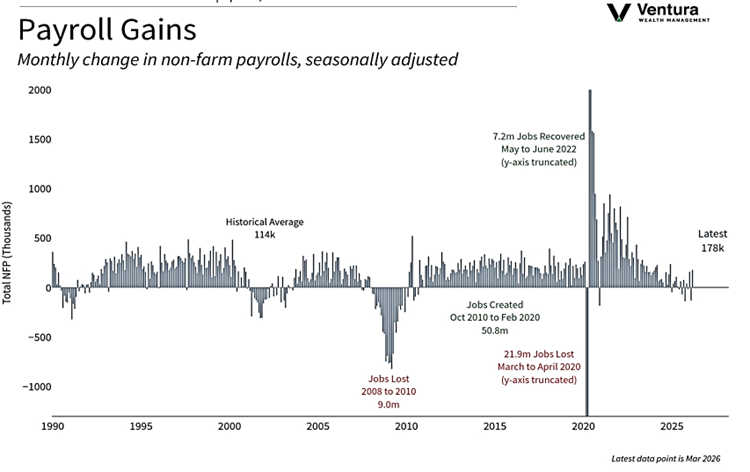
The March employment report showed the U.S. economy added 178,000 jobs, while the unemployment rate declined to 4.3%. Both figures came in better than analyst expectations. Healthcare was responsible for much of the jobs gains.
Source Materials
Market Moving Events:
MarketWatch.com
Chart of the Week:
Clearnomics,
Bureau of Labor Statistics
Statistic of the Week:
The Wall Street Journal
Global Perspective:
The Economist
Commentary:
1. Barron’s
2. Bloomberg
3. Bloomberg
4. Yahoo! Finance
5. MarketWatch.com
6. The Economist
7. The Economist