
The Financial Advocate: Winter 2026
“Conundrum”
Welcome to 2026! We face conflicting economic, political, and market signals every day. Economic numbers in the United States look generally good: the economy is growing, corporate profits are higher, and labor seems relatively balanced. Since the start of the year, there has been a noticeable, underlying churn in the investment markets. So, why all this “chop?” Here are a few potential reasons:
- Expectations are high. If a company reports great sales and earnings, but suggests they are cautious about the rest of the year, the stock price suffers. Prudent management and guidance is being punished in the equity markets. As investors, we value prudent, realistic management and guidance.
- Inflation remains stubbornly above the Fed’s target of 2%. Most inflation measures, including the Fed’s preferred gauge (the PCE Index), are hovering between 2.5-3%. This is putting a damper on expectations of future rate cuts. Fewer rate cuts implies a higher cost of capital for companies, meaning slower earnings growth.
- Interest rates appear to be holding steady. We see yields of about 4% for 10year Treasuries and 6% mortgage interest rates. 6% mortgage rates are well within historic norms. (Some of us remember 15% mortgage rates). However, appreciation in home values since the pandemic has priced out many first-time home buyers. While rates appear “normal,” the housing market faces ongoing challenges. Tariff uncertainty (cost of materials), slowing new home construction, and labor issues are all contributing factors beyond rates and prices.
- There is a narrative that AI will not just disrupt, but destroy, certain industries. Yes, disruption from AI is here, and we expect that disruption has just begun. No one knows just how broad or destructive the AI revolution will ultimately be. However, the market is acting in extremes. Companies that are showing some promise are being disproportionately rewarded, while their competitors are being unfairly punished. The implication is that today’s leader has an insurmountable advantage that their competitors will never be able to overcome. This is not how free markets have behaved in the past. Just because a company has “first mover advantage” does not mean that they will completely dominate an industry group in perpetuity.
There are real risks, in any market, at any time. We must maintain a balanced approach to asset management.

Right now, it seems to us that the major risks the investment markets face stem from the political and geopolitical arenas. Issues do need to be addressed, and hopefully, non-violent solutions will begin to unfold. While we acknowledge domestic and international risks, these issues are, for the most part, out of our control. Thankfully, we can vote, but beyond that, resolution of these matters rests in the hands of others.
At VWM, the majority of portfolios invest in more than just the U.S. equity markets. Even though the evening news focuses almost exclusively on “how the stock market is doing today,” significant portions of many portfolios act independently of the machinations of the major equity indices. This is good news!
For diversified investors, the trends influencing many asset classes are generally positive. Stocks continue to see increasing profits, bond yields are stable, and commodities are trending higher. Economies around the globe are performing well. The U.S. is strong, and Europe and emerging markets are also improving. South America and Asia are both coming out of their respective slumbers. International equity markets have been performing well and provide diversification benefits.
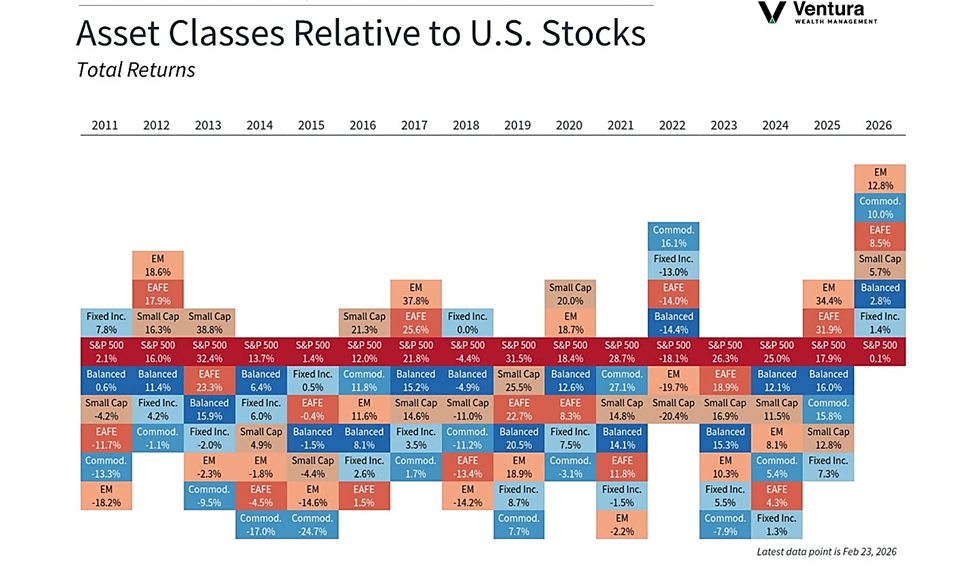
The chart above shows how different asset classes have performed since 2011. The dark red box represents the performance of the S&P 500. Other boxes represent distinct asset classes relative to their performance of the S&P. For most of the past 15 years, the S&P has been the standout performer. However, since the start of 2025, we have seen other asset classes (developed & emerging international equities, commodity markets, even fixed income) demonstrate strong returns. Diversification is back in vogue.
Gold deserves a mention. The precious metal posted its best performance in nearly four decades in 2025. We use gold in our portfolios as a hedge against sharp movements in financial markets. There are several recent trends impacting the price of precious metals worth noting.
Gold is being accumulated globally, by central banks, investors, and traders, as a hedge against volatility in the U.S. dollar and the debasement of fiat currencies. Because the globe predominantly trades its goods in U.S. dollars, if the dollar moves too much, it makes merchants and bankers nervous. Additionally, countries around the globe are running major budgetary deficits. These deficits undermine the foundation of national currencies. Historically, gold has been an excellent store of value. Beyond that, some unfriendly countries, like Russia, China, and Iran, recognize that they can be “cut off” from a U.S. dollar centric system. We believe these trends are likely to stay intact for the foreseeable future. We are not speculating in precious metals, but acknowledge that if trade is less stable, gold is a solid alternative.

What about crypto? While some investors have done extremely well trading cryptocurrencies (of which there are over 22,000), speculation is rife and maintaining these holdings is not for the faint of heart. There is little reason for most investors to think of crypto as the “new gold,” as it has not proven itself to be a strong hedge in the financial markets. We do, however, believe it should be viewed as a financial asset class with distinct characteristics. Those characteristics are far from what we see in “normal”/traditional asset classes. Crypto ownership is not for everyone.
In closing, domestic equity markets are near all-time highs with corporate profitability rising. Many major economic indicators have readings on the better side of average. This is not a time to be too pessimistic. It is a time to be realistic. We will be mindful of economic and political events to craft portfolios designed to be diversified and profitable within defined risk parameters. We expect 2026 to be more volatile than the last several years, but that does not mean it will offer fewer rewards. They just may be a little harder to find!
“Economist’s Corner,” by Roger Klein, Ph.D.
On Friday January 30, President Trump appointed Kevin Warsh as the next Chair of the Federal Reserve. Mr. Warsh previously served as a Federal Reserve governor between 2006 and 2011. It is not clear how the nomination will proceed. North Carolina senator Tom Tillis has said that he will not permit any nomination to proceed until the Justice Department investigation regarding Jay Powell is completed. For now, Stephen Miran continues to serve as a governor. Miran’s term officially ended on January 31,2026, but he will remain a governor until his replacement, Kevin Warsh, is confirmed by the Senate.
Jay Powell’s term as Chair ends on May 15, 2026. His term as Fed governor ends on January 31, 2028. So Powell could remain as a Fed governor after his term as Fed Chair ends. In the past, other Fed Chairs have retired from the Board after their terms as Chair ended. Powell has not said what he will do after May 15.
The Federal Open Market Committee (FOMC) met on January 24 and January 25. After cutting the target federal funds rate at its prior three meetings, the FOMC decided to keep the target interest rate between 3.5% and 3.75%. The FOMC statement said that economic activity was expanding at a solid pace and the unemployment rate had stabilized. There was no longer a reference in the statement to a weakening labor market being a bigger risk than inflation.
The FOMC voted 10-2 to keep the target interest rate unchanged. The two dissents, one from governor Miran and the other from governor Waller, argued for a 0.25% reduction in the target interest rate. Chair Powell said that the current target interest rate is at the upper end of neutral so there is room for some further reductions if monetary ease is required.
Managed Model Strategy
Global Alpha
Global Alpha has been challenging! We continue to believe in the technology sector but have lightened our holdings slightly due to volatility. Our core beliefs remain the same as we look for new opportunities in emerging markets. We are strongly overweight in materials and industrials, as we believe the U.S. “rebuilding” trend is real. In our opinion, the consumer looks relatively strong; therefore, consumer discretionary stocks continue to find a home in our portfolios. AI is disrupting certain industries, and we remain mindful of its impact. We have increased—and will continue to increase— our international holdings, as various parts of the globe are growing nicely.
Global Balanced
The Global Balanced portfolio has continued to perform well despite choppy domestic equity markets. Broad diversification across sectors, industry groups, asset classes, and geographies supported performance in 2025 and has continued to contribute positively thus far in 2026.
In recent weeks, we unwound several tax-loss harvesting positions in taxable accounts that had been established to help manage capital gains exposure for 2025. We modestly reduced large-cap domestic equity exposure while increasing allocations to developed and emerging international markets. We also added selectively to small-cap equities and initiated positions in companies we believe were overly penalized during the recent market pullback, using weakness as an opportunity to upgrade quality. Conversely, strength in certain holdings provided an opportunity for disciplined profit-taking. We believe diversification will remain a key theme in the year ahead.
Moderate Allocation
The Moderate Allocation portfolio benefited as U.S. risk assets posted modest but positive returns in Q4 2025. We made several changes to our equity holding as investors are displaying an intolerance for anything that has slowing growth or the possibility of being disrupted by AI. Gold and our high quality fixed income allocations remain in place. On a macro level, real GDP growth slowed to about a 1.4% annualized pace in the quarter, with easing consumer spending and hiring consistent with a soft landing rather than a recession. Inflation continued to trend lower on a year over year basis but remained above the Fed’s 2% target, keeping policy makers cautious. Against this backdrop, the Federal Reserve delivered an additional 25 bp cut in December, reinforcing a gradual shift from restrictive toward more neutral policy and modestly improving the outlook for fixed income duration and interest rate sensitive equities. Broadening participation from small and mid-cap stocks suggests the market can continue to advance in the months ahead.
Cash Flow Discipline

Maintaining a healthy savings rate and disciplined cash flow remains one of the most important—yet often overlooked— drivers of long-term financial success. Even in uncertain environments, consistent saving strengthens balance sheets, builds flexibility, and keeps long-term goals on track. While inflation has moderated, it remains above prepandemic norms, and many households continue to experience gradual lifestyle drift. Periodic reviews of savings habits, retirement contributions, and discretionary spending help ensure continued progress.
Distribution discipline is equally critical, particularly for retirees and during periods of market volatility. A structured withdrawal approach—focused on sustainable spending, tax efficiency, and coordination across account types—can help preserve capital, smooth tax outcomes, and extend portfolio longevity. Across all life stages, thoughtful cash flow management supports financial independence and helps keep short-term decisions aligned with long-term objectives.

This quarter, we will look at the topic of “Cash Flow Discipline.” We will focus on key savings and spending metrics to help you understand how your saving and spending habits are ultimately impacting your portfolio and not just your current, but future net worth.
As always, we are happy to discuss these items with you in your quarterly reviews. If you have immediate questions, please reach out to your VWM Wealth Manager.
Until spring,
Nick Ventura
Founder and CEO