
The Financial Advocate: Spring 2026
“Who Would Believe…”
That despite a months-long conflict involving Iran, continued disruption around the Strait of Hormuz, elevated oil prices, and heightened geopolitical uncertainty, equity markets would still be trading near all-time highs? Oil prices remain elevated, gasoline prices have risen meaningfully, and inflationary pressures continue to work their way through the global economy. Beyond gasoline, products tied to energy and global shipping, fertilizer, airline fuel, helium used in semiconductor manufacturing, and industrial materials have all experienced upward pricing pressure. With the U.S. midterm elections now just months away, the political backdrop remains unsettled as well.
So, what has allowed markets to remain resilient? Corporate earnings. Profit growth has continued to surprise to the upside, particularly in industries tied to artificial intelligence, semiconductor demand, data center construction, power infrastructure, and industrial services. Corporate profitability remains the lifeblood of the stock market, and investors continue to reward companies that demonstrate durable and consistent earnings growth.

That said, risks remain. Inflation is still elevated. Historically, higher inflation has often led to higher interest rates. Over time, rising rates can pressure corporate margins, weaken housing affordability, and slow economic growth. The Federal Reserve also faces a difficult balancing act. While markets initially expected new Fed Chair Kevin Warsh to favor lower interest rates, elevated inflation may limit the central bank’s flexibility. In today’s interconnected, global economy, inflationary pressures tied to food, semiconductors, pharmaceuticals, rare earth minerals, copper, aluminum, and energy markets can quickly ripple across borders.

Global affairs remain complex. China continues to dominate portions of the manufacturing and rare earth supply chain, while energy markets remain highly sensitive to developments involving Russia and Iran. At the same time, there are constructive developments worth noting. Economic relationships and trade activity with India, parts of South America, and portions of Southeast Asia continue to strengthen. While globalization has created vulnerabilities, it has also created opportunities.

Against this backdrop, one theme stands above all others: artificial intelligence. A.I. has the potential to reshape nearly every aspect of the economy, from healthcare and pharmaceuticals to logistics, manufacturing, and financial services. While sensible oversight and ethical guardrails will be important, the pace of innovation remains remarkable. Companies such as Alphabet, Amazon, OpenAI, and Anthropic are helping drive this transformation as the demand for computer power is fueling rapid growth in semiconductors, data centers, and utility infrastructure. Many noted experts believe we are still in the early stages of this technological shift.
Two additional technological developments also deserve mention. First, the next phase of space exploration and commercialization continues to accelerate. Increased satellite deployment, launch capabilities, communications infrastructure, and private-sector investment are rapidly expanding the industry. Second, quantum computing is advancing from theory toward practical application. While still early in development, the technology has the potential to dramatically expand computing capabilities and solve problems that were previously impractical or impossible using traditional systems.

As always, our responsibility is not to predict headlines, but to analyze market trends as they develop. We continue to closely monitor inflation, interest rates, earnings trends, trade developments, and geopolitical risks. We remain focused on managing portfolios based on what is happening – not what we hope will happen. While the world is changing rapidly, disciplined investing, thoughtful research, and a focus on long-term corporate profitability remain at the core of our approach.
“Economist’s Corner,” by Roger Klein, Ph.D.
Last summer, the then Federal Reserve Chair Jay Powell said the U.S. labor market was in “a curious kind of balance” where both the demand and supply of labor were declining. How did he come to this observation?
We get our information on the labor market through the monthly employment report from the Bureau of Labor Statistics (BLS). The next BLS employment report will be released on Friday June 5th and will provide data for the month of May.
The BLS employment report relies on two surveys, the establishment survey and the household survey. The establishment survey is a survey of approximately 119,000 business establishments and 622,000 work sites. These businesses report monthly on the number of workers on their payroll. The monthly change is reported as the increase or decrease in non-farm jobs. In April, the increase in jobs was 115,000. This number will be revised when the next report is released on June 5th, but it was encouraging since there had been little job growth over the past twelve months. In April, job gains occurred in health care, transportation and warehousing and retail trade. Federal government employment continued to decline. Since reaching a peak in October 2024, federal government employment is down 348,000, or 11.5 percent. Employment in information technology continued to trend downward, dropping 13,000 jobs in April. Information technology employment is down by 342,000 or 11.0 percent since its most recent peak in November 2022.
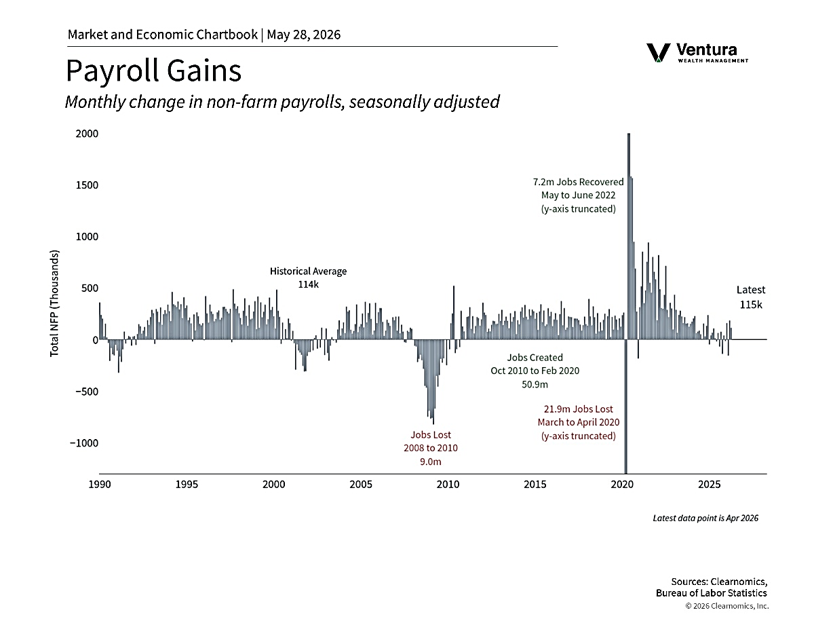
These data from the establishment survey tell us that job growth is weak. The year-over-year gain in jobs is a meager 0.16 percent. The average yearly percentage gain since 1970 is 1.47 percent. The behavior of these data over the past year is consistent with the onset of recession.
The household survey tells another story. The BLS surveys 60,000 households each month. Initially, the BLS asks each individual if they are employed. If they say “yes,” they are considered employed. If they say “no,” then they are asked if they looked for work in the last four weeks. If they say “yes,” then they are considered unemployed. If they say “no,” they are considered not in the labor force.
This category, “not in the labor force” tells us about the supply of labor. Over the past year, it has grown by 2.816 million and it now totals 104.959 million. The labor force fell by 1.059 million over the past year and now totals 169.995 million. The labor force is declining as the “Baby Boomer” cohort begins retirement. In addition, the large increase in financial wealth has enabled younger workers to take early retirement. Finally, net migration has declined over the past year. In 2026, net immigration is zero. In 2024, it was 2.5 million and 2025 it was 500,000.
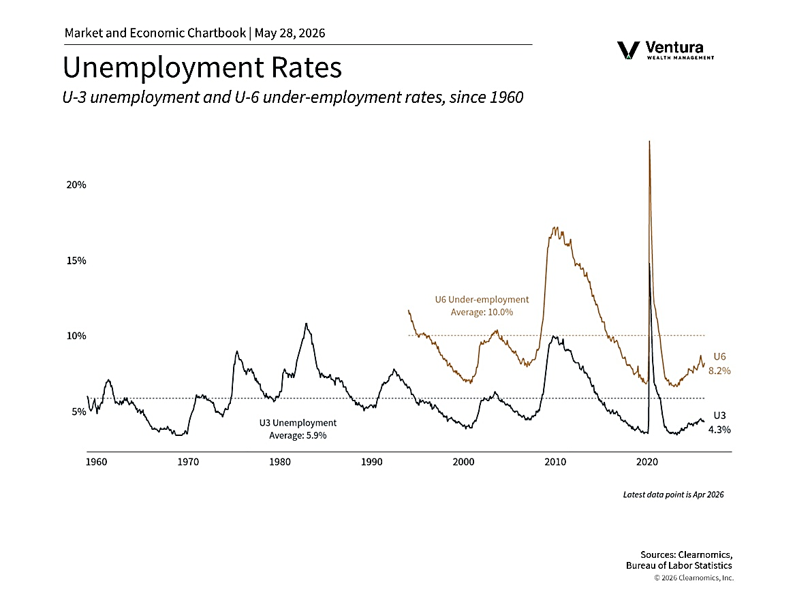
The household survey yields the unemployment rate, the number of unemployed divided by the labor force. The unemployment rate in April was 4.3 percent. This is a low number historically, but it is higher than the recent cycle low of 3.4 percent. The average unemployment rate since 1960 is 5.9 percent. Given the weakness in job growth, the unemployment rate remains surprisingly low. At the same time, data on initial unemployment insurance claims is at historic lows. The combination of low job growth and low unemployment claims has encouraged commentators to use the phrase describing the labor market as “low hire, low fire.” We will continue to closely follow the monthly employment reports from the BLS to see if this remains a good description of the labor market and whether a “curious kind of balance” remains in place.
Managed Model Strategy
Global Alpha
Global Alpha continues to be overweight technology and communications; these areas have been very strong in recent months. To counterbalance technology, we have holdings in industrials and materials. These industries represent the onshoring of American industry, the build-out of data centers for A.I., and our electrical grid. We are increasing our energy holdings as we believe energy demand is growing strongly, both here in the U.S. and abroad. To round out the portfolio, we have select healthcare and financial investments, in addition to direct investments in Brazil and Taiwan.
Global Balanced
The diversification within the Global Balanced portfolio has continued to support consistent performance despite elevated market volatility and geopolitical uncertainty. Exposure across multiple asset classes has helped reduce day-to-day fluctuations, with positions in managed futures, commodities, precious metals, and fixed income serving as stabilizing components within the portfolio structure. Both domestic and international equity allocations have contributed positively to results. Periods of sharp appreciation in certain holdings created opportunities for disciplined profit taking during the quarter. In taxable accounts, the portfolio also engaged in selective tax-loss harvesting, as tax awareness remains an important part of the strategy. Fixed income investments have faced headwinds in this inflation regime, though recent weakness allowed the portfolio to refresh portions of its maturing Treasury bond holdings at more attractive yield levels.
Moderate Allocation
The Moderate Allocation portfolio has benefited as equities have drifted higher over the last few months. The macro backdrop has been defined by sticky inflation risks, tariff pass-through, and a labor market that is cooler than last year but still expanding. These factors have been challenging for fixed income investments. However, our holdings in high-quality bonds and Treasury Inflation Protected Securities have outperformed. We recently trimmed some of our A.I.-related winners and sold some of our underperformers. We also upgraded our holdings in the health care sector. We believe that the Federal Reserve is “on hold” for the time being. However, the economy is growing and corporate earnings are expanding, despite the developments in the Middle East.
Milestone 360

Tax Diversification in Your Portfolio
Many investors focus heavily on diversifying their investments but often overlook diversifying their future tax exposure. This quarter’s Milestone 360 topic examines the tax structure of your portfolio and how different account types may impact long-term outcomes.
Areas of focus include:
- Tax-deferred vs. Roth vs. Taxable Investment Accounts
- Which types of investments may be most appropriate for certain account structures
- Roth conversion strategies
- IRMAA and Medicare-related income considerations
- Required Minimum Distributions (RMDs)
- The long-term tax implications of large traditional IRA balances
Within a comprehensive financial plan, tax diversification can be nearly as important as asset allocation itself. A thoughtful tax structure may improve flexibility, create planning opportunities, and help reduce the impact of taxes over time.
VWM Update
Exciting things continue to happen at VWM.
Our team continues to grow. We recently welcomed Roman Chiokadze as a Wealth Manager. Roman previously worked with New York Life and its affiliate, Eagle Strategies. He is a graduate of West Chester University and holds the Retirement Income Certified Professional® designation. Welcome aboard, Roman!
We are also proud to announce that, after months of dedicated preparation, Lucas Morreale passed the Certified Financial Planner™ examination and is now a CFP® professional. The CFP® exam is widely regarded as one of the most rigorous designations in the financial planning industry, with only about 65% of candidates passing on their first attempt. Congratulations, Lucas!
A few weeks ago, VWM hosted its second annual Economic Forum for clients across the tri-state area. Roger Klein, our Chief Economist, led the event with a presentation focused on stagflation and the current economic environment. We are excited to continue growing this event in the years ahead.

As always, we thank you for your business and continued trust in our firm.
Enjoy the summer!
Nick Ventura
Founder and CEO