
The Profit Margin: March 9, 2026
Statistic of the Week
The average 30-year mortgage rate fell to its lowest level since 2022, reaching 5.98% two weeks ago. However, jitters in the bond market pushed the yield on the 10-year Treasury higher. Mortgage rates tend to track movements in the 10-year Treasury, and as of Friday, the average 30-year mortgage rate has edged up to 6%. Even so, this remains well below the levels seen at the start of 2025, when mortgage rates were above 7%.
Global Perspective
In trading history dating back to 1983, West Texas Intermediate (WTI) crude oil futures recorded their largest weekly price increase following U.S. and Israeli strikes on Iran. WTI surged approximately 35.6% for the week, while Brent crude, the global benchmark, rose roughly 28% amid fears of supply disruptions. A major driver of the move is concern surrounding the Strait of Hormuz, a critical shipping chokepoint through which roughly 20% of the world’s oil and natural gas supply normally flows.
Market Moving Events
Tuesday: Existing Home Sales
Wednesday: CPI
Thursday: Jobless Claims, Building Permits, Housing Starts, Trade Deficit
Friday: GDP Revision, Personal Income and Spending, PCE (January), Durable Goods Orders, JOLTS
Commentary
Market action last week was driven by two primary developments: the conflict between the U.S./Israel and Iran and a weaker-than-expected February payrolls report. All three major domestic equity indices finished the week lower. The Dow Jones Industrial Average led the declines, falling 3.01% and slipping into negative territory for the year.1 The S&P 500 dropped 2.02%, marking its worst weekly performance since October.2 The Nasdaq held up relatively better, declining 1.24% despite falling in seven of the past eight weeks.3 Investors found little relief in fixed income markets, as bond yields moved higher. The yield on the 10-year Treasury rose 0.09% over the week to close Friday at 4.13%.4
February’s employment report showed the U.S. economy losing 92,000 jobs (chart right).5 While part of the weakness can be attributed to a large healthcare worker strike, job gains in December and January were also revised lower by a combined 68,000.6 Since May, the labor market has seen little net job creation,7 though importantly, it has not experienced widespread job losses either. This “no hire, no fire” environment is occurring alongside persistently elevated inflation. This week’s CPI and PCE readings will provide further clarity on the inflation outlook. PCE is expected to show inflation at 2.9%, with core near 3.1%.8 Meanwhile, oil futures moved above $100 per barrel last night,9 raising concerns that higher energy prices could complicate the inflation picture and increase the risk of a stagflationary environment. With earnings season largely behind us, economic data and geopolitical developments are likely to be the primary drivers of markets in the near term.
Chart of the Week
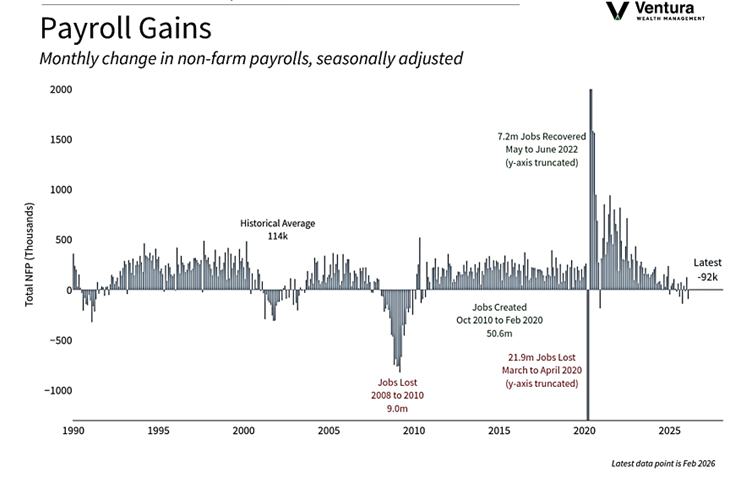
In the monthly nonfarm payrolls report, the U.S. economy lost 92,000 jobs in February. Expectations were for a gain of roughly 59,000. The unemployment rate ticked up from 4.3% to 4.4%.
Source Materials
Market Moving Events:
MarketWatch.com
Chart of the Week:
Clearnomics,
Bureau of Labor Statistics, Reuters
Statistic of the Week:
CNN.com
Global Perspective:
CNBC.com
Commentary:
1. Bloomberg
2. Bloomberg, Investor’s Business Daily
3. Bloomberg, Investor’s Business Daily
4. MarketWatch.com
5. Bureau of Labor Statistics
6. Bureau of Labor Statistics
7. Investor’s Business Daily
8. MarketWatch.com
9. CNBC.com